Revelation Bible Study Notes: Chapter 1–3
Introduction: Keys to Understanding the Apocalypse
To properly read the Revelation of Jesus Christ to St. John, one must have a thorough understanding of the Old Testament. St. John frequently utilizes OT imagery and allusions, as well as New Testament writings (the Gospels and Pauline Epistles) that were in use by the early Church.
- Title: Revelation (Singular). There is only one revelation.
- Purpose: To show His servants what is to come. A blessing is promised to those who read, hear, and keep these words.
- The Occasion: Written in 95 A.D. during the reign of Emperor Domitian. As Christians were being martyred for refusing to worship the Emperor, St. John wrote to inspire faithfulness across all of human history.
The Language of Symbols
Revelation is written in an apocalyptic style, meaning an “unveiling.” It uses a specific “language” of numbers, colors, and objects.
1. Biblical Numerology
| Number | Meaning |
| 1 | Unity, God |
| 3 | The Trinity |
| 4 | The World (four corners) |
| 6 | Incomplete, sinful man |
| 7 | Completion and Perfection |
| 12 | The Church (Apostles/Patriarchs) |
| 3 ½ | Persecution/Tribulation (allotted time) |
2. Colors and Objects
- White: Purity, victory, holiness.
- Red: Blood, fire, sacrifice, the Holy Ghost.
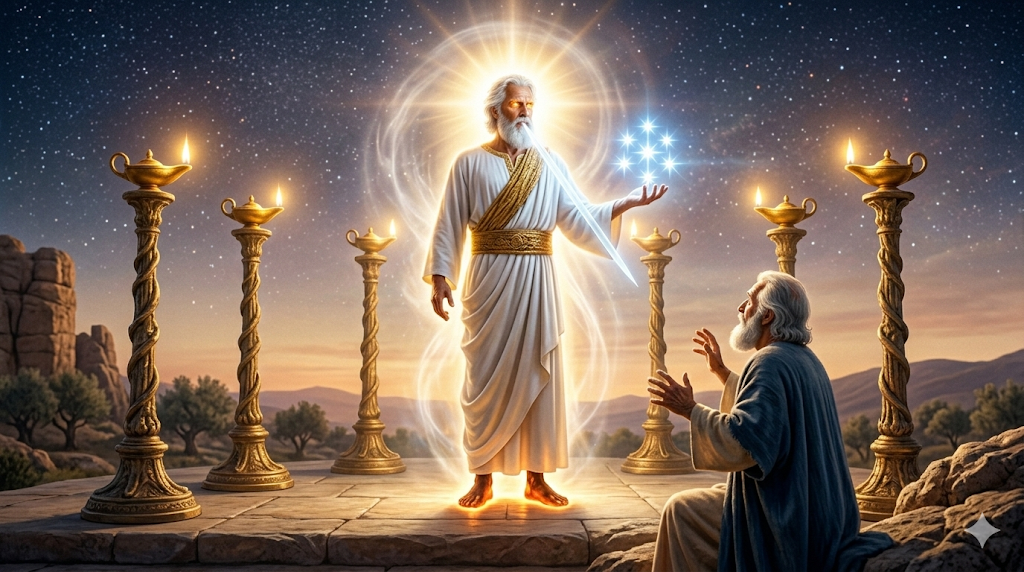
- Lampstand: The Churches; the Light of Christ.
- Trumpet: Announcement of an event.
- Sea: Evil human government.
- Land: Organized religion distinct from Christian faith.
Chapter 1: The Vision of the Son of Man
The Salutation (1:4-8)
Jesus is identified in His threefold office: Prophet (Faithful Witness), Priest (Firstborn of the dead), and King (Ruler of the kings of the earth).
The Introductory Vision (1:9-20)
St. John, exiled on the Isle of Patmos, was “in the spirit on the Lord’s Day” (Sunday).
- The Voice: Like a trumpet, commanding him to write to the seven churches.
- The Appearance of Christ: * Eyes like flame: Omniscience and holy wrath.
- Feet like burnished brass: Unholiness cannot withstand His path.
- Two-edged sword: The Word of God (Law and Gospel).
- Seven Stars: The pastors/angels of the churches held in His protective right hand.
Chapters 2-3: The Letters to the Seven Churches
These letters represent prophetic types of church conditions that persist until the end of the world.
Summary of the Seven Churches
| Church | Characterization | Key Message |
| Ephesus | The Loveless Church | “You have abandoned your first love. Repent.” |
| Smyrna | The Persecuted Church | “Be faithful unto death, and I will give you the crown of life.” |
| Pergamum | The Compromising Church | Beware the “teaching of Balaam” and the Nicolaitans. |
| Thyatira | The Corrupt Church | Reproof for tolerating “Jezebel” and false teachings. |
| Sardis | The Dead Church | “You have a name of being alive, but you are dead.” |
| Philadelphia | The Faithful Church | An open door that no one can shut. |
| Laodicea | The Lukewarm Church | “I will spit you out of my mouth.” |
Deep Dive: Selected Insights
- Ephesus (2:1-7): Known for testing false apostles but rebuked for losing their initial fervor.
- Smyrna (2:8-11): A poor city where Christians were spiritually rich. They faced the “Synagogue of Satan.”
- Pergamum (2:12-17): Located where “Satan’s throne” was. They are promised “hidden manna” and a “white stone” (symbolizing acquittal and a new name).
- Thyatira (2:18-29): The longest letter to the smallest city. Rebukes the “deep things of Satan” taught by a false prophetess.
- Sardis (3:1-6): A city of “precious stones” that lived on past prestige. Christ warns them to “wake up” before the remaining embers of faith die out.